FIG. 09 — FOUNDER
The Person Behind the Prototype
Footstep Energy Harvester is designed, built and documented by Samyak Patni — an independent student exploring engineering through hands-on making.
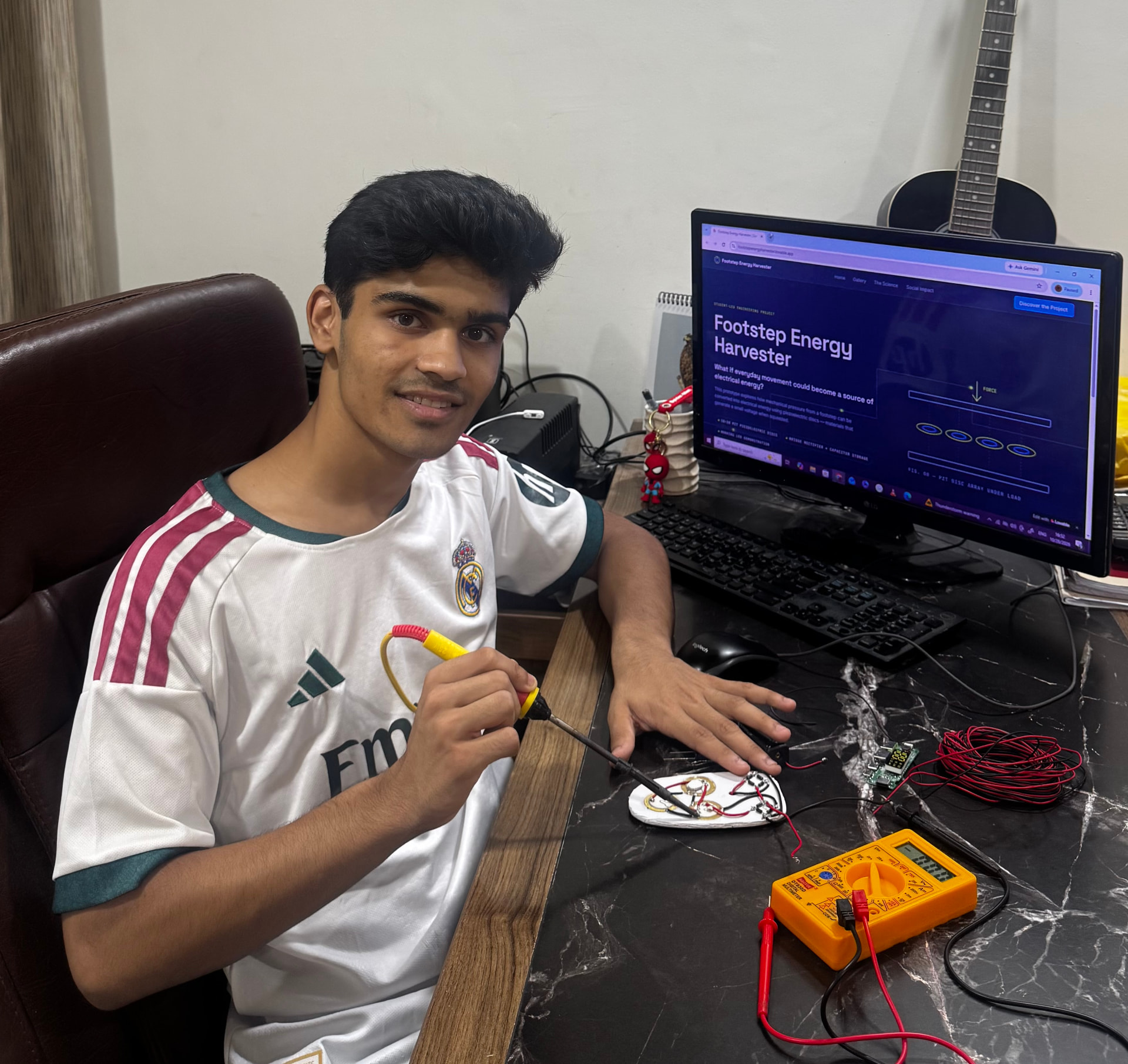
PROFILE
Samyak Patni
Builder of this project — from the first question about footsteps and energy, through the physics, the soldering and the testing, to the honest look at what the prototype can and can't do yet.
A pursuit of knowledge
This project is an independent student build: every photo, measurement and limitation on this site is documented honestly, with no made-up numbers.
FIG. 08 — REFLECTION
What Building This Project Taught Me
Piezoelectricity
I learned how certain crystals and ceramics produce a voltage when they are mechanically stressed.
Circuit Design
I learned why parallel wiring, rectification and storage each matter in a low-power circuit. I also learned how to use soldering to efficient build circuits and systems.
Hardware Prototyping
I learned how to turn a sketch into a physical build that can survive repeated pressing.
Measurement
I learned to use a multimeter carefully and to report only what I can verify.
Troubleshooting
I learned to isolate faults one stage at a time when the circuit didn't behave as expected.
Sustainable Technology
I learned that energy harvesting is promising but small-scale, and that honest limits matter: small-small steps towards a greener future.
“This project taught me that engineering is less about getting a perfect result and more about understanding why something works — and being honest about what it can and can't do yet.”
METHOD
How I Approach an Engineering Problem
01
Ask a Question
02
Understand the Physics
03
Design & Plan
04
Build & Execute
05
Test to collect data and analyse
06
Identify Limitations
07
Find scopes of improvement
ROADMAP
What Comes Next?
- ProposedHow to scale the project and make a prototype that is effective and visually aesthatic.
- ProposedEstimate energy produced per press and calculate the optimal number or discs to use
- ProposedStudy how disc arrangement affects output
- ProposedInvestigate capacitor charging behaviour
- ProposedImprove mechanical stability of the plates
Current Limitations
Limitations
- Generates low magnitude charges
- Fluctuating supply
- Durability
- Scalability and Comfort
- Low efficiency through the circuit
- Visually not appealing